Research Areas
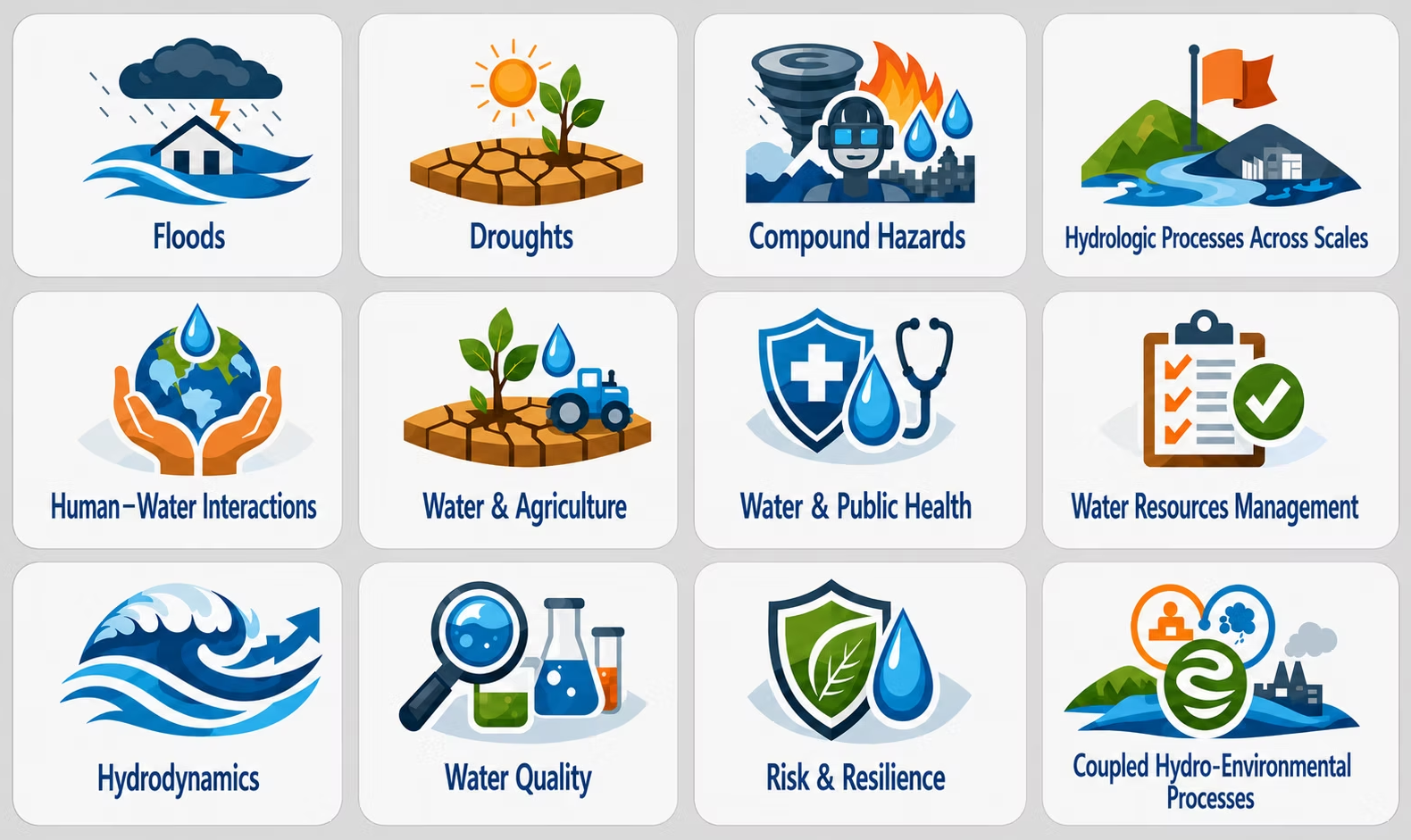
We work at the intersection of hydrology and advanced computational methods, including machine learning and artificial intelligence. Our interdisciplinary research spans hydrological extremes and natural hazards, coupled hydroclimatic processes, human–water interactions, water for agriculture, ecosystems, and public health, and integrated risk and resilience.
Research Approach
Our research integrates hydrologic and environmental process understanding with data-driven, computational, and domain-specific numerical modeling approaches to address interdisciplinary problems. We develop and apply AI/ML methods, leverage a wide range of datasets, and use process-based numerical models to better understand, predict, and manage complex water-related systems.
Our work spans the full spectrum from fundamental scientific discovery and methodological development to prediction, risk assessment, and decision support. We are particularly interested in approaches that advance scientific understanding while improving our ability to make informed decisions.
AI/ML Philosophy
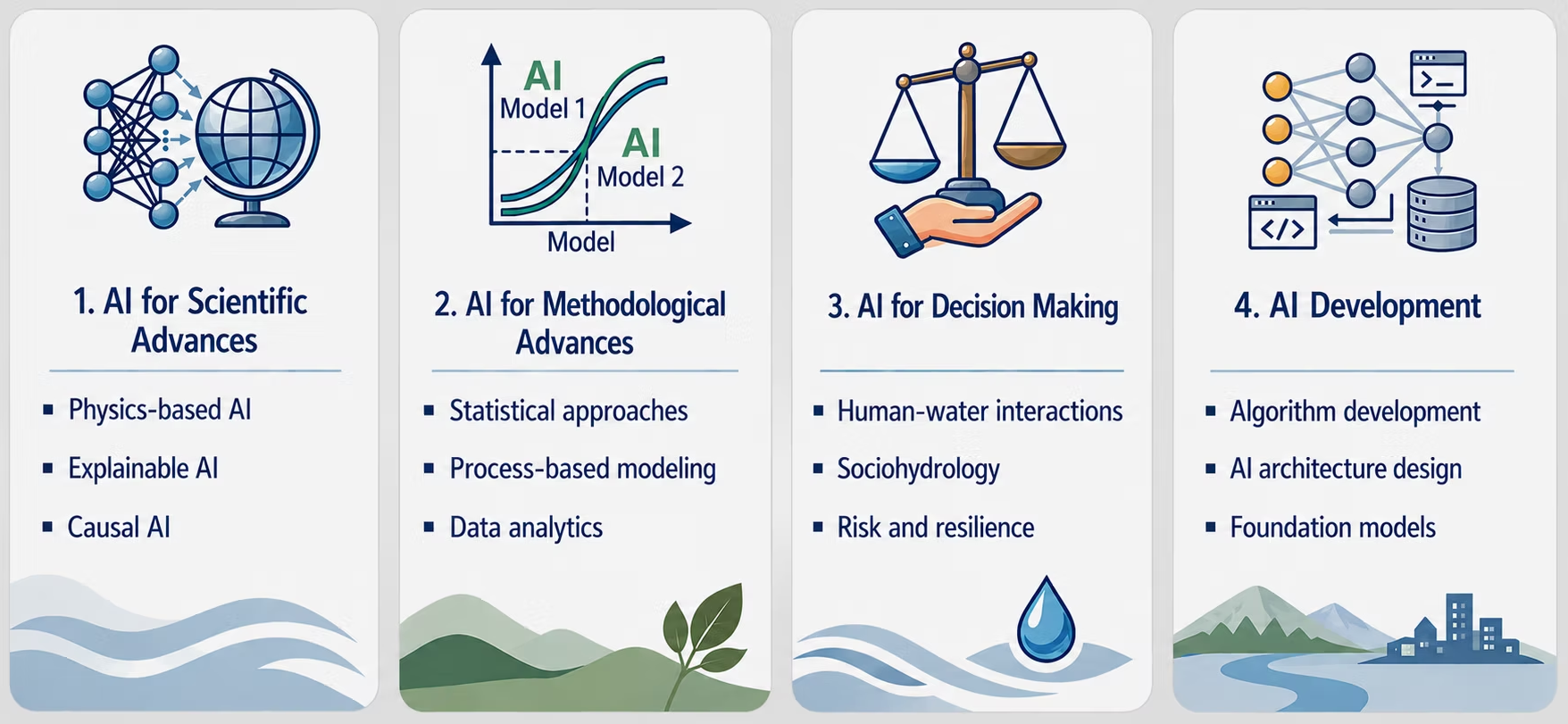
We view AI/ML not simply as a predictive tool, but as a framework for advancing scientific understanding and developing new approaches to complex hydrologic problems. Our work in this area spans four broad themes: scientific discovery, methodological advances, decision-making, and algorithm development.
Research Impact
These are examples, not an exhaustive list, of some of our impactful research over the last few years. We are actively working on several of these topics, with additional publications planned for the future.
Rain-on-Snow & Snow Hydrology:
We conducted the most comprehensive global assessment of rain-on-snow (ROS) flooding and proposed an improved definition of these events that addresses key shortcomings in existing approaches (Kumar et al. 2025). We have also investigated the atmospheric dimensions of ROS events, including the role of turbulent heat fluxes (Suriano et al. 2026), their representation in numerical models (Dixon et al. 2026), and the broader climatological context of these events (Suriano et al. 2025). We have explored the role of snow processes in hydrologic modeling from an operational perspective (Rasiya Koya et al. 2023). Our ongoing research is expanding into the hydrological dimensions of ROS, with several new research directions underway.
Drought Assessment:
Collectively, our work examines different aspects and types of droughts. We worked on improving the hydrological drought monitoring capability of the U.S. Drought Monitor by incorporating spatially distributed hydrological information generated through the NASA Land Information System (Kumar et al., in prep; Lahmers et al., in prep). This work also involved CONUS-scale hydrological model parameter calibration and regionalization within the context of drought. We have investigated how flash droughts (Das et al. 2026) may change in the future and their association with compound meteorological extremes, and we have proposed new approaches for monitoring snow droughts (Rasiya Koya et al. 2023). PI Roy has also investigated the role of precipitation recycling in drought mitigation (Roy et al. 2019).
Wildfire Hydrology:
This is an actively evolving research area in the lab, with several directions planned for future work. In our previous work, we investigated the physical and biogeochemical drivers of post-wildfire solute mobilization and fluxes in the critical zone (Sanchez et al. 2023). Ongoing research in our group is examining droughts in the context of wildfire occurrence and impacts.
Hydrological Impacts of Conservation Practices:
We conducted the most comprehensive review (Srivastava et al. 2023) and exploratory data analysis (Srivastava et al. 2026) on how conservation practices impact watershed hydrology. This in-depth assessment revealed important complexities in these interactions, with significant implications for agricultural water management. We have worked on modeling both surface water and groundwater systems within this context using the SWAT and MODFLOW models (Spor Leal et al. in prep). We are currently actively working in this area, focusing on large-scale implementation of the SWAT+ and MODFLOW models to analyze a wide range of management and hydrologic scenarios.
Hydrology of Non-perennial Streams:
We conducted a comprehensive assessment of the unique nonlinear characteristics of non-perennial streams and highlighted their importance for water resources decision-making (Kar et al. 2024). We further investigated the role of atmospheric moisture in shaping non-perennial streamflow dynamics and analyzed their causal drivers and underlying mechanisms (Kar et al., in review). This remains an active research area in our group, with several directions planned for future work.
Resilient Infrastructure, Compound Hazards & Integrated Risk:
We mapped integrated flood risk and its drivers by combining hazard, exposure, vulnerability, and response (Srivastava and Roy 2023, Srivastava et al. 2024). This was the first quantitative risk assessment to explicitly incorporate the response dimension alongside the other major components of risk, thereby providing a more realistic representation of risk. We are currently working on modeling compound extreme-event hazards, with a focus on understanding interactions among multiple drivers and their combined impacts. This remains an active area of research in our group, with growing interest in understanding infrastructure resilience and its role in shaping overall risk.
Streamflow Process Understanding, Modeling & Forecasting:
Collectively, our work on streamflow modeling and forecasting spans a broad range of methods, scales, hydroclimatic conditions, and applications. Several of our machine learning studies are framed around streamflow forecasting (Rasiya Koya and Roy 2024). We improved the hydrological component of the Iowa Flood Forecasting System to better represent snow processes (Rasiya Koya et al. 2023). We also investigated key drivers of streamflow across different hydroclimatic conditions (Almagro et al. 2024) and proposed an aridity index-based formulation for characterizing streamflow components (Meira Neto et al. 2020). PI Roy developed the Multi-Model Streamflow Forecasting (MMSF) platform, which integrates multiple precipitation products and hydrological models while explicitly accounting for forecast uncertainty (Roy et al. 2016).
Water & Public Health:
We are actively working to better understand the public health implications of flooding. In our previous work, we incorporated health-related drivers into integrated flood risk assessments (Srivastava et al. 2024). Our water quality research also inherently includes a public health dimension. We plan to expand this area significantly, with a growing focus on the connections among hydrological extremes, water quality, and public health.
Human-Water Interactions & Sociohydrology:
We are actively developing advanced frameworks for decision-making related to agricultural conservation practices and sustainable water management (Shrestha and Roy, in prep). We have proposed reinforcement learning as a pathway for addressing sociohydrologic problems, explicitly capturing the two-way feedback between human actions and the responses generated by those actions (Roy et al. 2024). We plan to further expand this area by developing efficient computational approaches for representing human–water interactions and improving decision-making in complex water systems.
Groundwater Modeling:
Our group uses MODFLOW for groundwater modeling (Spor Leal et al., in prep). We further developed a robust package for the fully three-dimensional implementation of the Richards equation in MODFLOW-6 (Vazquez-Gasty et al. in review). PI Roy has used the finite element-based OpenGeoSys model to simulate groundwater processes in the context of saltwater intrusion (Roy et al. 2016).
Water Quality Assessments:
We strive to bridge the gap between water quantity and water quality assessments, as the two are inherently interconnected. We have examined water quality in the context of wildfire impacts using Critical Zone Observatory (CZO) datasets (Sanchez et al. 2023) as well as data collected through household surveys. Our projects have also incorporated water quality assessments in the context of evaluating the hydrologic impacts of conservation practices (Srivastava et al. 2026), including their effects on nitrate dynamics. This is an active and growing area of our research, with ongoing work aimed at more closely integrating water quantity and quality processes.
Large-Scale Product Intercomparison:
We have contributed to several large-scale model and product intercomparison efforts. Under the Great Lakes Runoff Intercomparison Project, we compared the performance of 13 hydrological models in simulating runoff (Mai et al. 2022). We evaluated precipitation and temperature forecasts from 16 models in the North American Multi-Model Ensemble at the global scale (Roy et al. 2020). PI Roy also contributed to one of the most comprehensive precipitation intercomparison studies to date, involving 26 different precipitation products (Beck et al. 2019).
AI/ML Research Innovations
Physics-Based Machine Learning:
We are actively working on algorithm-level advances in machine learning to more deeply embed physical principles into model architectures and learning processes. In our recent work, we implemented three types of physical constraints in LSTM models, including mass, energy, and storage-discharge constraints, to improve physical consistency (Pokharel et al. 2023). This is a rapidly evolving research area in our group, with several new directions planned for the future.
Explainable & Causal Machine Learning:
We work extensively on explainable AI approaches to better understand model behavior and uncover the physical processes underlying model predictions. Our work includes techniques such as SHAP (Kar et al. 2025) and causal analysis (Kumar et al. 2025), with the broader goal of making machine learning models more scientifically interpretable and useful for process understanding.
Temporal Fusion Transformers:
We were the first to implement Temporal Fusion Transformers (TFTs) in hydrology (Rasiya Koya and Roy 2024). This work set a new benchmark for streamflow forecasting by combining the attention mechanisms of Transformers with the recurrent learning capabilities of Long Short-Term Memory (LSTM) networks.
Kolmogorov-Arnold Networks:
We were the first to implement Kolmogorov-Arnold Networks (KANs) in hydrology (Liu et al. 2025). These networks provide enhanced explainability, supporting improved understanding of underlying physical processes.
Machine Learning-Based Uncertainty Analysis:
We proposed an algorithm that combines Long Short-Term Memory (LSTM) networks with Mixture Density Networks (MDNs) and jointly optimizes accuracy and precision, enabling streamflow forecasting with realistic uncertainty assessment (Kumar et al. 2026).
Machine Learning-Based Irrigation Scheduling:
We proposed a machine learning-based irrigation scheduling framework that integrates indicators of soil moisture deficit, plant water stress, and atmospheric demand, providing a holistic approach to irrigation decision-making (Srivastava et al. 2024).
Machine Learning-Based Snow Drought Index:
We developed a new index for monitoring snow droughts using self-supervised autoencoders (Rasiya Koya et al. 2023). The framework also examines the role of different drivers using an information theory-based approach. This generalizable framework can be adapted to monitor and understand a wide range of environmental hazards.
Products: Datasets & Models
HLM-Snow: The Hillslope Link Model (HLM) serves as the hydrologic core of the Iowa Flood Forecasting System. We enhanced HLM by incorporating snow processes with the goal of improving streamflow simulations. Publication: Rasiya Koya et al. 2023 | Model Code: Available upon request.
CaBra: Large sample catchment-scale hydrological dataset for Brazil. Publication: Almago et al. 2021 | Data Source: Zenodo
HYMOD2: An improved version of the widely used lumped hydrological model HYMOD. Publication: Roy et al. 2017 | Model Code: HydroShare
SPSM: We developed a physically based conceptual model for simulating snow processes, called the Snow Processes Simulation Model (SPSM). The model was presented at the 2015 AHS Annual Symposium (Roy et al., 2015). The associated report and model code are available upon request.
Programming & Models
Most of our work involves coding, but we also have experience with a wide range of models and modeling systems.
Programming: We primarily code in Python and extensively use TensorFlow, scikit-learn, and PyTorch. We also have experience with MATLAB, R, and Fortran.
Physically-Based Models: SWAT, SWAT+, Noah-MP, LIS, LIS/WRF-Hydro, VIC.
Conceptual Models: HYMOD, HBV, HEC-HMS, HLM.
Statistical Models: HEC-SSP.
Hydraulic Models: HEC-RAS.
Groundwater Models: MODFLOW, OpenGeoSys.
